
Why hospitality businesses need connected agencies, not channel suppliers
The agency model separates disciplines because it is easier to package and sell them that way. Hospitality does not work like that, and the gaps between the packages are where performance goes.
Most hospitality businesses I talk to do not have a channel problem. They have a connection problem, and it is being diagnosed as a channel problem because that is the shape of the suppliers available to fix it.
Here is what it looks like from the inside. The paid media agency reports a good month. The website agency reports a good quarter. The CRM is being managed by someone in the commercial team. The photography was shot two years ago by a studio nobody has spoken to since. Every one of those relationships is performing against its own brief, and the commercial result is still flat.
Nobody in that picture is doing a bad job. The problem is that no one is accountable for the space between them.
The packaging problem
The traditional agency model separates disciplines because separation makes them sellable. A retainer needs a scope. A scope needs a boundary. The boundary is drawn around a channel, because channels are the thing clients already have budget lines for.
That is a commercial convenience, not a description of how growth works. A guest does not separate brand from content, content from website, website from booking journey, or booking journey from the stay itself. Those things either reinforce each other or they create friction, and the friction does not show up in any single supplier’s report.
Where the gaps actually are
Four of them come up again and again.
- The advertising cannot see the journey. Campaigns are optimised against platform-reported conversions, which means budget flows to whatever the platform can claim, not to whatever the business actually needs sold.
- The website cannot see the audience. Landing pages are built from the brand brief rather than from the audience the campaigns are buying, so the promise in the ad and the promise on the page are not the same promise.
- The CRM cannot see behaviour. First-party data sits in the PMS, the booking engine and the email platform in three shapes that do not reconcile, so segmentation stays generic.
- The content cannot see performance. Creative is judged on whether the client likes it, because nobody has connected it to the campaigns it feeds.
Each of those gaps is small. Together they are usually the difference between a business that grows and one that spends more to stand still.
What connected actually means
It does not mean one supplier doing everything. Plenty of agencies claim full service and deliver five separate teams behind one invoice, which is the same problem with better paperwork.
It means the disciplines share a model of the business. The people running the ads know what the booking journey does. The people building the site know what the campaigns are buying. The people making the content know which audience it has to persuade and at which point. And someone is holding the whole thing against a commercial outcome rather than a set of channel targets.
In practice, that shows up in unglamorous ways. A landing page changes because the ad account learned something. A campaign gets restructured because the booking data showed the offer was wrong. A shoot list gets rewritten because the creative testing said so. None of those decisions can be made inside a single channel brief.
The honest test
Ask your suppliers a question that crosses a boundary and see what happens. Something like: of the guests we acquired last quarter, which ones came back, and what did we do differently for them?
If the answer requires three different people, a spreadsheet and a fortnight, that is the gap. It is not anyone’s fault. It is just nobody’s job.
That is the space we think an agency should be working in now — not instead of channel expertise, but on top of it. The specialisms still matter enormously. What has changed is that the value has moved to the joins.

The hidden cost of disconnected hotel technology
Every department chose a good system. The guest experiences the result, and the cost of the gaps between them never appears on anyone’s budget.
19 May 2026 · 6 min read
Buy and build is the realistic future of hospitality technology
Building everything is slow and expensive. Buying everything means accepting a guest journey shaped by someone else’s roadmap. The advantage sits in the final layer.
14 Apr 2026 · 6 min read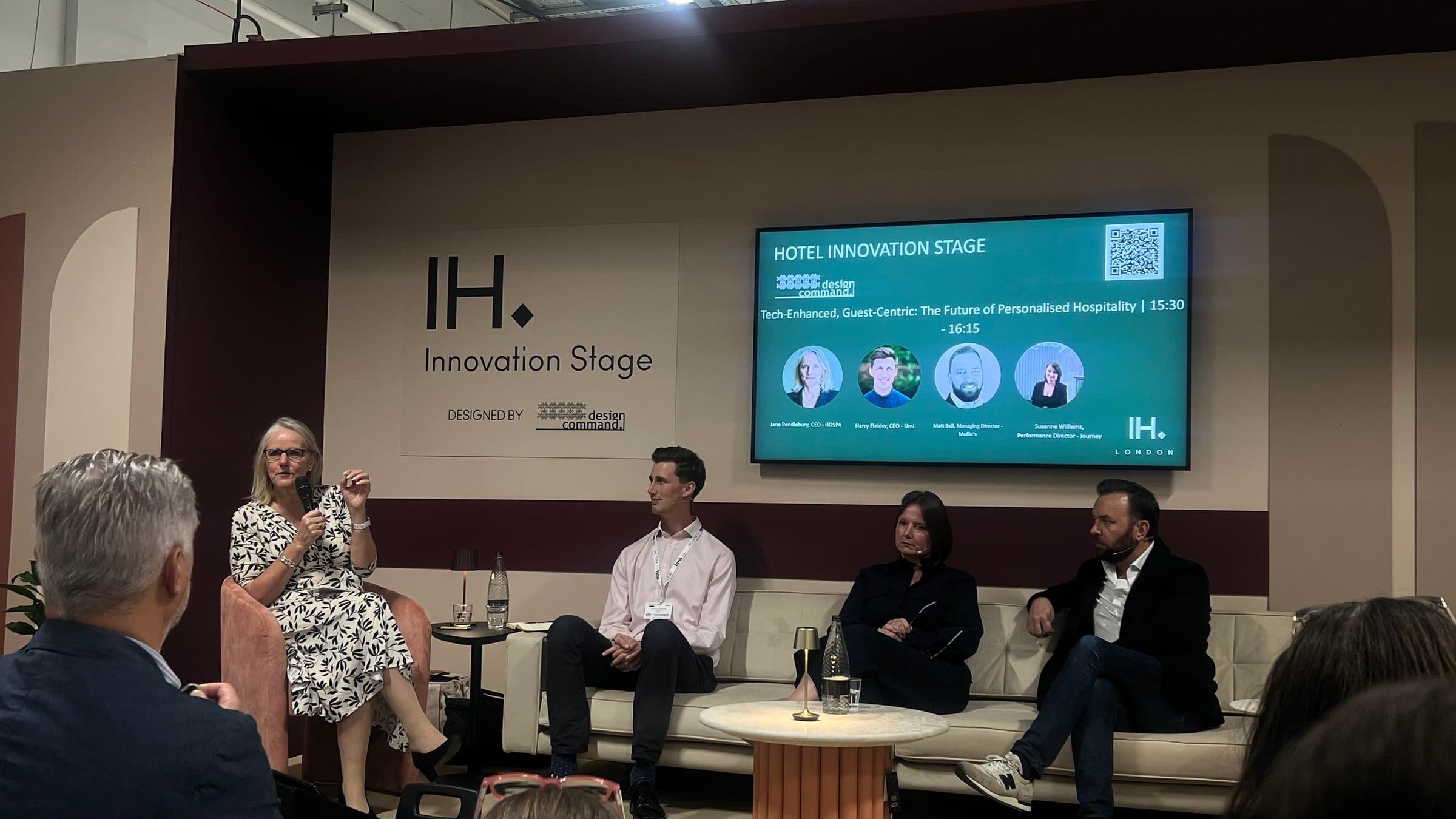
Technology, people, and the future of personalised hospitality
Notes from the Innovation Stage at the Independent Hotel Show, on what personalisation actually asks of a hospitality team — and where the technology stops and the people start.
08 Oct 2025 · 7 min read